

Chartered Accountancy coaching isn’t a ten-week test-prep sprint — it’s a multi-year commitment spanning Foundation, Intermediate, and Final levels, often stretched across two to four years per student. That long runway is exactly why finance coaching institutes bleed students silently. A learner who vanishes in month 14 of an 18-month Inter batch doesn’t complain or ask for a refund — they just stop showing up, and by the time the front desk notices, the seat, the fee installment, and the eventual placement story are all gone. Generic coaching-center software built for six-month exam batches was never designed to catch this kind of slow-motion churn.
This is where purpose-built CA coaching institute software changes the outcome. Instead of reacting to a no-show after three missed classes, the right CA coaching institute software flags fee delays, attendance gaps, and disengagement signals while there’s still time to intervene. Below are five specific, high-leverage ways CA coaching institute software helps CA, CS, and CMA coaching institutes stop losing students to no-shows — grounded in what actually makes finance coaching different from a typical exam-prep center.
Table of Contents
Why CA, CS, and CMA Coaching Is a Different Beast for Institute Management
Most coaching verticals — JEE, NEET, banking exams — run on 6 to 12 month cycles with a single make-or-break test date. CA, CS, and CMA coaching runs on a completely different clock. A student enters at Foundation, spends 4-6 months preparing, sits for an exam, then moves into Intermediate for another 8-10 months, often while juggling articleship or a day job, before finally reaching Final. Across that 2-4 year journey, motivation dips are inevitable, family and financial pressures pile up, and every additional term is another exit ramp.
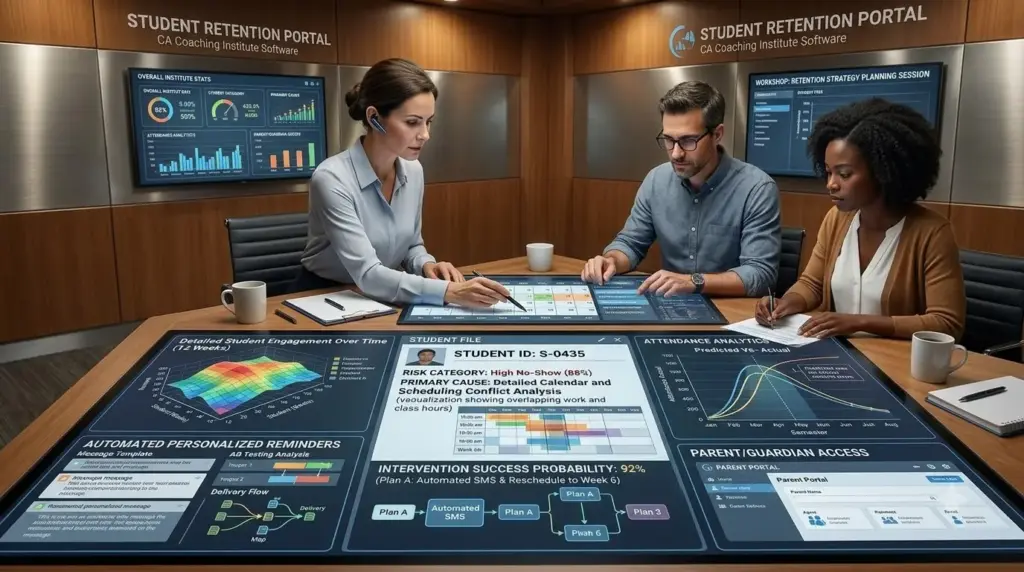
That structural difference is why dropout risk in finance coaching behaves so differently from a short-term batch. A missed week in a 3-month crash course is a bad sign; a missed week in month 9 of an Intermediate batch can be the first thread of a slow unraveling that takes 60 days to fully surface. Institutes running CA, CS, and CMA batches on spreadsheets and WhatsApp groups typically don’t notice the pattern until the student has already mentally checked out — and by then, win-back is far harder than early intervention. Purpose-built CA coaching institute software exists precisely to compress that 60-day blind spot down to a same-week alert, because this multi-year, high-stakes structure is exactly what CA coaching institute software needs to be designed around from day one.
5 Ways CA Coaching Institute Software Stops Students From Becoming No-Shows
Here are the five levers that matter most once you’re evaluating or configuring CA coaching institute software for a Foundation-to-Final program.
1. Automated Fee-Installment Reminders for Multi-Level Courses (Foundation, Inter, Final)
Finance coaching fees are rarely paid in a single lump sum. Institutes typically split fees by level — Foundation, Intermediate, Final — and then split again by installment within each level, sometimes stretching six or more payments across an 18-month program. Every one of those installment dates is a natural exit point: a student who’s already wavering will use a missed or upcoming payment as the socially acceptable reason to quietly stop attending rather than admit they’re struggling with the syllabus or the pace.
Manual fee follow-up — a front-desk call, a WhatsApp reminder typed out one student at a time — breaks down exactly when institutes are managing 300-plus students across three levels and multiple batches. Reminders get sent late, or not at all, and by the time someone calls about an overdue installment, the student has already missed two weeks of classes and mentally moved on. This is one of the most preventable causes of no-shows in long-duration finance coaching.
CA coaching institute software fixes this by automating the entire installment calendar per student, per level. Instead of one static due date, the system tracks Foundation fees, Intermediate fees, and Final fees separately, triggers WhatsApp and SMS reminders 7, 3, and 1 day before each due date, and escalates to staff only when a payment is genuinely at risk of lapsing. Because the reminders are automated and level-aware, a student moving from Foundation to Intermediate doesn’t fall into a billing gap where nobody in the office realizes a new fee cycle has started. The result: fewer “I stopped coming because I couldn’t pay and was embarrassed to ask” dropouts, and a much earlier warning system for institutes to offer flexible plans before a student disappears entirely.
2. Attendance Tracking Tied to ICAI’s Mandatory Attendance Requirements
ICAI mandates minimum attendance percentages for students to be eligible to sit for Intermediate and Final exams, which means a student who quietly stops attending isn’t just falling behind academically — they may be forfeiting their exam eligibility altogether without realizing it until it’s too late. That regulatory layer raises the stakes of every missed class far beyond what a typical coaching institute has to manage, and it’s a pressure unique to CA, CS, and CMA programs.
This is exactly where generic registers fail finance coaching institutes. A paper attendance sheet or a shared Excel file can’t calculate a rolling attendance percentage against a regulatory threshold in real time, and by the time an institute manually tallies attendance at the end of a term, a student may have already crossed the point of no return on eligibility — with no time left to recover it. Institutes then face an uncomfortable conversation days before an exam, instead of a preventable one months earlier.
CA coaching institute software paired with proper attendance management software solves this by tracking attendance digitally per session, calculating live eligibility percentages against ICAI norms, and flagging any student who drops below the safe threshold — automatically, in real time, without a staff member running the numbers. Institutes can then intervene with makeup sessions, parent calls, or revised schedules while the student is still recoverable, rather than after eligibility is already lost. Attendance data tied directly to regulatory thresholds turns a compliance requirement into your earliest, most reliable no-show warning system.
3. Batch and Rank-Based Scheduling for Long-Duration Courses
An 18-24 month CA Intermediate program can’t run on one fixed timetable the way a 3-month crash course can. Students join at different points, repeat specific subjects after an unsuccessful attempt, or need to be regrouped by performance level as some pull ahead and others fall behind. Static, one-size-fits-all scheduling — the kind most institutes default to when they’re managing timetables manually — quietly punishes both ends of that spectrum: strong students get bored and disengage, while struggling students get left in batches that move too fast for them, and both groups become flight risks for no-shows.
Rank-based and subject-wise batch scheduling addresses this directly, and it’s exactly the kind of flexibility CA coaching institute software needs to provide out of the box. Rather than keeping every Intermediate student in one undifferentiated batch for two years, CA coaching institute software should let institutes create dynamic batches — a faster-track group for students clearing subjects on the first attempt, a reinforcement batch for repeat-subject students, and rolling intake batches for latecomers — and reshuffle students into the right group as performance data comes in from test series and mock exams.
This matters enormously for retention because a mismatched batch is one of the quietest reasons students disappear from long-duration coaching: nobody files a complaint about being bored or overwhelmed, they just stop attending. Software-driven scheduling that responds to rank and subject-level performance, rather than a rigid academic calendar, keeps students in a batch where they’re actually being served — often the difference between a student who finishes Final and one who becomes a silent no-show in month eleven.
4. Parent and Student Progress Communication That Closes the Trust Gap
Most CA, CS, and CMA students are working with articleship commitments, family financial pressure, or a career-change timeline riding on their results — which means parents and, in many cases, employer-sponsors want visibility into progress that a typical coaching institute never has to provide. When that visibility doesn’t exist, families default to assuming things are fine right up until a student quietly drops out, at which point the institute is the last to know and the first to be blamed.
Manually updating parents — a phone call here, a report card there — doesn’t scale past a handful of students and tends to happen only when there’s already a problem, which is too late to be useful as an early-warning tool. What finance coaching institutes need instead is a steady, automated drip of test scores, attendance percentages, and batch progress that reaches parents and students on a predictable schedule, regardless of whether anything is currently wrong.
CA coaching institute software with built-in progress communication solves this by auto-generating and sending performance summaries after every test series, attendance digest, and batch milestone — via WhatsApp, SMS, or email — without staff having to compile anything by hand. When a dip in scores or attendance shows up, parents see it in the same weekly update rather than finding out only after their child has already stopped coming to class. That transparency does double duty: it builds the kind of trust that keeps families invested in a multi-year program, and it gives institutes an early, shared signal to intervene before disengagement turns into a full no-show — another area where CA coaching institute software pays for itself quickly.
5. Lead Follow-Up for Admission Cycles That Never Really Stop
Unlike school-year-bound coaching, CA, CS, and CMA admissions run in continuous, overlapping cycles — new Foundation batches start multiple times a year, Intermediate re-registrations happen after every exam result, and Final-level admissions trickle in from students transferring institutes mid-journey. That means the “admission season” for finance coaching never fully closes, and leads that aren’t followed up within days go cold fast, especially when a prospective student is comparing three or four institutes at once.
Institutes relying on a notebook or a shared spreadsheet for enquiries routinely lose leads simply because nobody followed up before the prospect enrolled somewhere else — and worse, they lose visibility into which enquiry source (walk-in, referral, Google, social) is actually converting, so marketing spend keeps getting allocated blind. Just as sports academy CRM systems help sports academies capture and convert trial-class enquiries before they go cold, CA coaching institutes need the same discipline applied to admission enquiries that arrive at any point in the year.
This is where lead follow-up automation inside CA coaching institute software earns its keep: every enquiry — walk-in, website form, referral — gets logged automatically, assigned to a counselor, and followed up with scheduled reminders until it converts or is explicitly closed. Because CA, CS, and CMA prospects often need multiple touchpoints to decide, given the multi-year cost and time commitment they’re evaluating, automated, persistent follow-up converts significantly more enquiries into enrollments than a best-effort manual process ever will — directly protecting the admissions pipeline that funds the rest of the institute.
How to Choose the Right CA Coaching Institute Software for Your Institute
Choosing CA coaching institute software isn’t a simple checklist exercise, because not every all-in-one platform actually understands the multi-year, regulation-bound nature of CA, CS, and CMA coaching. When evaluating CA coaching institute software, look specifically for level-wise fee configuration (Foundation, Inter, and Final as separate fee structures rather than one flat course fee), attendance tracking that can be configured against ICAI-style eligibility thresholds, batch management that supports rank-based regrouping rather than fixed cohorts, and built-in communication tools that reach parents as well as students.
It’s also worth checking whether the platform is genuinely built as academy management software covering the full student lifecycle — leads, admissions, fees, attendance, and communication in one system — rather than a point solution for just one of those functions that you’ll still have to stitch together with spreadsheets. A fragmented stack recreates the exact blind spots that cause no-shows in the first place: a fee reminder tool that doesn’t talk to your attendance tracker will always miss the student who’s falling behind on both at once.
No-shows in CA, CS, and CMA coaching rarely happen overnight — they build up over weeks through missed fee installments, slipping attendance, mismatched batches, and silence from the institute. The five fixes above aren’t independent tools; they work best as one connected system, which is exactly what dedicated CA coaching institute software is designed to be — and why more finance coaching institutes are replacing spreadsheets with CA coaching institute software each year. Institutes that adopt it don’t just plug leaks — they get the early-warning data to fix problems while a student is still recoverable, not after they’ve already left.
Frequently Asked Questions
What makes CA coaching institute software different from regular coaching center software?
CA coaching institute software is built for multi-year, multi-level programs across Foundation, Intermediate, and Final, with level-wise fee structures, attendance eligibility tracking, and rank-based batch management, none of which typical short-term coaching software is designed to handle.
How does CA coaching institute software help reduce student dropouts?
It surfaces early warning signs such as missed fee installments, falling attendance, mismatched batch pacing, and cold admission leads automatically, so institutes can intervene weeks before a student disengages completely instead of noticing only after they have already stopped attending.
Can CA coaching institute software track ICAI attendance eligibility automatically?
Yes. The right CA coaching institute software calculates live attendance percentages against ICAI-style eligibility thresholds for every student and flags anyone approaching the minimum, giving institutes time to schedule makeup sessions before exam eligibility is affected.
Is CA coaching institute software useful for CS and CMA institutes as well?
Yes. CS and CMA programs share the same multi-level, multi-year structure as CA coaching, so the same fee automation, attendance tracking, batch scheduling, and lead follow-up features apply directly to CS and CMA institutes.
How quickly can a CA coaching institute set up this kind of software?
Most institutes can import existing student, fee, and batch data and go live within a few days, after which fee reminders, attendance tracking, and lead follow-up start running automatically without manual setup for every batch.
Stop Losing CA, CS, and CMA Students to Silent No-Shows
If your finance coaching institute is still tracking fee installments, attendance eligibility, batch performance, and admission enquiries across separate spreadsheets and WhatsApp threads, the no-shows will keep slipping through unnoticed. See how purpose-built CA coaching institute software brings all of it into one system — Start Free Trial today, or Book a Demo to see it configured for your Foundation, Intermediate, and Final batches.
Discussion
Comments