
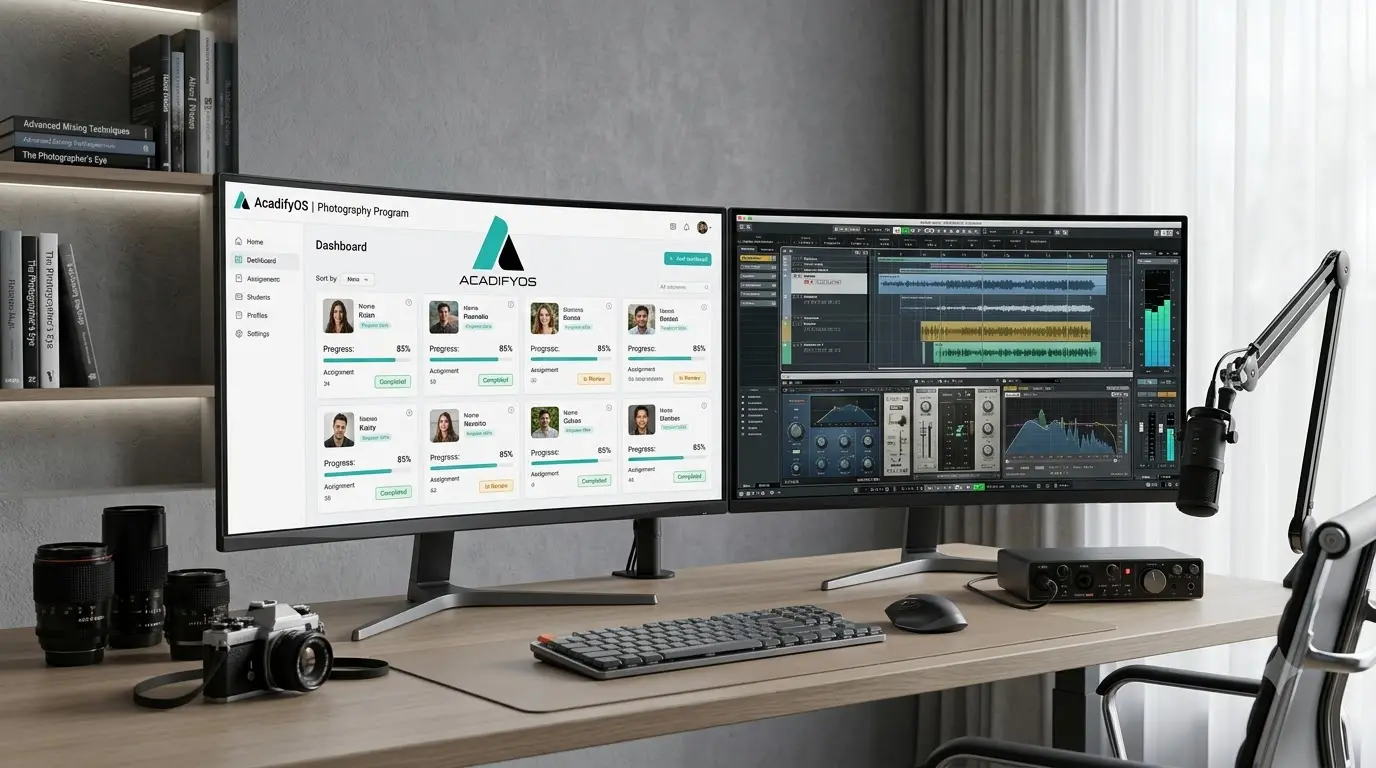
India’s photography and filmmaking academies are having a moment, and the operational demands on academy owners have grown just as fast as the demand from students. Between the explosion of content-creator culture on Instagram and YouTube, the growing wedding and commercial photography industry, and a new generation of students chasing careers behind the camera, enrollment at photography and film institutes across India has never been higher. Yet most of these academies are still run the way a neighborhood tuition center was run a decade ago: paper registers for equipment checkout, WhatsApp groups for batch schedules, and spreadsheets for fee tracking. That gap between a modern, camera-forward brand and back-office chaos is exactly why photography academy management software has become one of the fastest-growing categories of academy software in the country.
If you run a photography institute, film school, or videography training center, this guide walks through why the old way of managing operations is holding your academy back, what a purpose-built photography academy management software actually needs to do, and how to evaluate the right platform for your growth stage.
Table of Contents
Why Photography & Film Academies in India Are Outgrowing Spreadsheets
Unlike a typical tuition center, a photography or film academy has operational complexity that generic student-management tools were never built for. Consider what a mid-sized academy juggles in a single week: multiple batches running staggered schedules (weekday evening batches for working professionals, weekend intensives for students), a shared pool of expensive gear (DSLRs, mirrorless bodies, lenses, lighting kits, gimbals, drones) that has to be checked out and returned without loss or damage, practical assignments and portfolio submissions that need to be graded and tracked per student, and a fee structure that often includes installments tied to workshop modules rather than a flat monthly charge.
When all of this lives across a paper logbook, a shared Google Sheet, and three different WhatsApp groups, things slip. Gear goes missing because no one remembers who checked it out. Students miss submission deadlines because reminders never went out. Fee follow-ups get forgotten because there’s no automated nudge. A director spends hours every week just reconciling who paid what, instead of focusing on curriculum and placements. This is the exact problem photography academy management software is designed to solve — centralizing every operational thread of the academy into one connected system.
What to Look for in Photography Academy Management Software
Not every academy management platform on the market understands the specific workflows of a photography or film institute. Here’s what actually matters when you’re evaluating options.
1. Equipment & Gear Checkout Tracking
Cameras, lenses, tripods, lighting rigs, and drones are the single biggest capital investment most photography academies make — and the single biggest source of loss when tracked manually. A good system should let staff log gear checkout and return against a specific student and session, flag overdue equipment automatically, and maintain a full history of who used what, when, and in what condition. This alone eliminates one of the most common disputes academies have with students.
2. Batch & Workshop Scheduling
Photography academies rarely run a single uniform timetable. Between beginner DSLR batches, advanced cinematography workshops, weekend masterclasses, and one-off guest sessions, scheduling needs to handle overlapping cohorts, studio/room availability, and instructor allocation without double-booking a single studio space or camera kit.
3. Portfolio & Project Submission Tracking
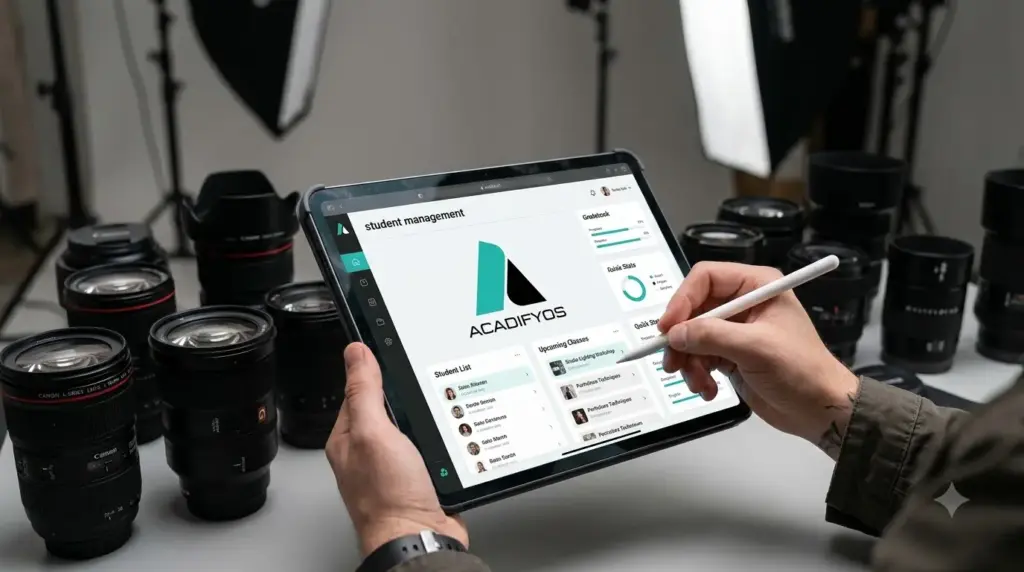
Unlike a typical academic course, photography and film training is assessed through practical output — shoot assignments, edited reels, portfolio pieces. The platform should let instructors track submission status per student, per assignment, and flag students who are falling behind before it becomes a dropout risk.
4. Fee Collection & Module-Based Billing
Many academies price by module (a basic photography course, an advanced lighting workshop, a full filmmaking diploma) rather than a flat monthly fee. Your fee management module needs to support module-wise billing, partial payments, and automated reminders — not just a single recurring invoice.
5. Attendance for Irregular Batch Timings
With weekend intensives, evening batches for working professionals, and occasional weekday workshops, attendance tracking has to be flexible enough to handle inconsistent schedules rather than assuming a fixed daily class.
6. Alumni & Placement Tracking
A strong placement record — student photographers landing studio jobs, filmmakers getting assistant-director gigs, freelancers building a client base — is one of the best marketing tools an academy has. Software that tracks alumni outcomes turns this into structured data you can use in admissions marketing instead of anecdotes.
7. Parent & Student Communication Automation
For younger students, and even for adult learners who forget schedule changes, automated WhatsApp/SMS notifications about upcoming shoots, gear return deadlines, and fee due dates save staff hours every week and dramatically cut no-shows.
8. Multi-Location Support
As academies expand into a second city or add a satellite studio, a single dashboard that shows enrollment, revenue, and gear inventory across every location becomes essential — rather than reconciling numbers city by city at month-end.
Signs Your Academy Needs Dedicated Photography Academy Management Software
Not sure whether your academy has actually outgrown manual tools? These are the warning signs owners of growing photography and film institutes report most often before they switch to dedicated photography academy management software.
- Gear disputes are becoming routine. Staff can’t confidently say who last checked out a specific lens or lighting kit, and “it was already like this” arguments are eating into instructor time.
- Fee follow-ups are inconsistent. Some students get reminded, others don’t, simply because a staff member forgot to scroll back through a chat thread.
- Batch clashes keep happening. Two cohorts get booked into the same studio slot because the schedule lives in someone’s head, not a shared system.
- You can’t answer basic growth questions quickly. If a co-founder asks “what’s our enrollment trend over the last two batches?” and the honest answer is “let me check three spreadsheets,” that’s a sign manual tracking has hit its ceiling.
- Submission deadlines slip without anyone noticing until it’s too late. Portfolio reviews and shoot assignments get lost in WhatsApp scroll instead of being tracked against a due date.
If two or more of these sound familiar, it’s a strong signal that photography academy management software will pay for itself within the first month, simply in hours saved and disputes avoided.
The Real Cost of Running a Photography Academy on Manual Systems
Academy owners frequently underestimate how much manual administration is actually costing them. A director spending 10-15 hours a week on fee follow-ups, gear reconciliation, and schedule coordination is a director not spending that time on curriculum quality, instructor hiring, or marketing to new students. AcadifyOS customers report an 80% reduction in admin burden after switching from manual systems to a connected academy management platform — time that photography academy owners redirect straight into growth activities like building industry partnerships and expanding their course catalog. This is the return on investment that makes photography academy management software worth adopting even for academies that consider themselves “too small” for dedicated software.
There’s also a revenue-leakage angle that’s easy to miss. Missed fee follow-ups, students who quietly drop out because no one flagged their falling attendance, and gear that “disappears” without any accountability trail all add up to real money left on the table every month. A platform built specifically for photography academy management software workflows closes these gaps automatically instead of relying on staff to catch every issue manually.
How AcadifyOS Supports Photography & Film Academies
AcadifyOS was built as a single operating system for every academy type — including creative and vocational institutes like photography and film schools — covering the full student lifecycle from the first inquiry to alumni tracking. For a photography or film academy specifically, that means one dashboard for lead capture and admissions, batch and studio scheduling, fee billing with module-wise plans, digital attendance, staff and instructor management, and automated WhatsApp/SMS communication — all connected instead of scattered across five different tools.
If you’re currently piecing together a spreadsheet, a WhatsApp group, and a paper equipment register, moving to a connected system isn’t just a convenience upgrade — it’s the difference between an academy that scales smoothly into a second batch or a second city, and one that stays capped by how much manual coordination one person can handle. You can Start Free Trial to see how AcadifyOS handles your specific batch and gear-tracking workflows, or Book a Demo with the team to walk through a setup tailored to your academy.
Choosing the Right Photography Academy Management Software
When evaluating vendors, look past the generic feature list and ask specifically: does this platform handle equipment checkout with an audit trail? Can it manage module-based fee billing instead of forcing a flat recurring charge? Does scheduling support overlapping weekend and weekday batches without conflicts? These are the questions that separate a true photography academy management software from a repurposed generic school ERP that happens to also work for a photography institute.
It’s also worth checking how the platform handles growth. An academy running one studio today may add a second location, launch an online cohort, or expand into videography and filmmaking courses within a year or two. Choosing software with multi-location support and flexible course/module structures from day one avoids a painful migration later.
Finally, don’t underestimate implementation speed. The best photography academy management software should be usable by non-technical staff within a day or two of onboarding — if a platform requires weeks of setup and training before your team can log a single gear checkout, it isn’t built for the fast-moving, hands-on culture of a working photography studio.
For reference on the broader category this fits into, see our guide to academy management software in India, and our breakdown of lead follow-up automation for turning inquiries into enrolled students faster. If attendance tracking for irregular batch schedules is a pain point, our post on attendance management software covers the fundamentals in more depth. Institutions building out a broader vocational or creative-training portfolio may also find our overview useful, alongside resources from the Film and Television Institute of India on industry training standards.
Photography and film institutes have a wrinkle most academy software ignores: expensive gear that needs to be checked out and returned per batch. Photography academy management software built for this workflow logs which student has which camera body or lens, alongside the usual batch fees and attendance, so nothing goes missing between semesters — a gap generic photography academy management software alternatives usually leave to a paper logbook.
Frequently Asked Questions About Photography Academy Management Software
What is photography academy management software?
Photography academy management software is a digital platform that centralizes the day-to-day operations of a photography or film institute — admissions, batch scheduling, equipment checkout, fee collection, attendance, and student communication — into one connected system instead of spreadsheets, paper registers, and WhatsApp groups.
How much does photography academy management software cost in India?
Pricing varies by platform and academy size, but most Indian academy management platforms, including AcadifyOS, offer tiered plans based on student count and modules used, with a free trial available so you can evaluate the fit before committing to a paid plan.
Can photography academy management software track camera and equipment checkouts?
Yes. A dedicated photography academy management software logs which student or instructor checked out which camera, lens, or lighting kit, when it is due back, and flags overdue equipment automatically, creating a full accountability trail that paper logbooks cannot match.
Is photography academy management software worth it for a small academy with one studio?
Even single-studio academies benefit significantly, since gear tracking, fee reminders, and batch scheduling become error-prone the moment more than a handful of students are enrolled at once. Most small academies see the admin-time savings pay for the software within the first month.
Does photography academy management software help with student dropout and retention?
Yes. By tracking attendance and portfolio submission deadlines in one place, the software flags students who are falling behind early, giving instructors and admissions staff a chance to follow up before the student quietly drops out of the course.
India’s photography and film academy market is only getting more competitive, and the institutes that win aren’t necessarily the ones with the fanciest studio — they’re the ones that run tight, professional operations behind the scenes while their instructors focus purely on craft. Investing in the right photography academy management software now sets your academy up to scale confidently, whether that means a bigger batch size, a second city, or an expanded course catalog. Start Free Trial today or Book a Demo to see AcadifyOS in action.
Discussion
Comments