
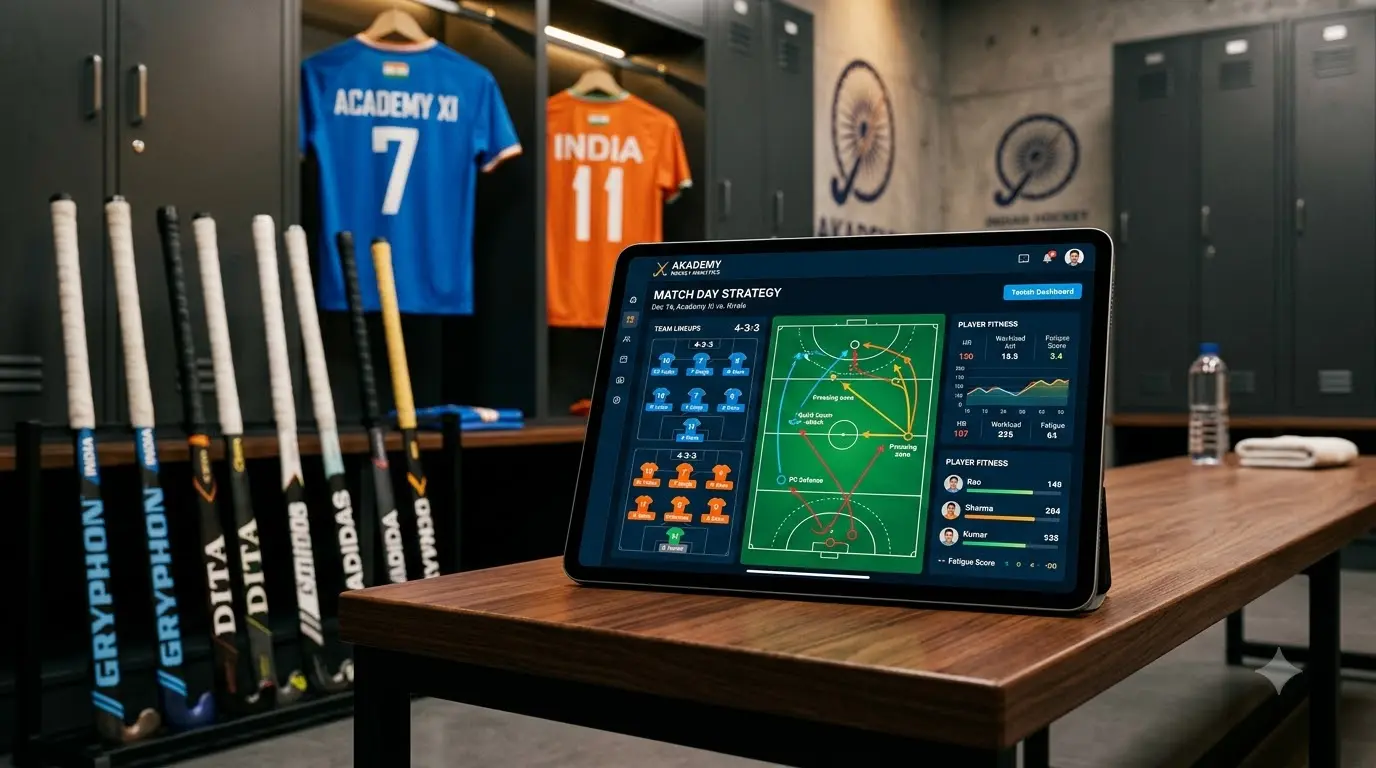
Indian hockey has not felt this alive in decades. Back-to-back Olympic bronze medals in Tokyo and Paris put the men’s national team back on the podium after a 41-year wait, and junior enrollment at academies across Punjab, Odisha, Jharkhand, and Tamil Nadu has surged in response. But the coaches who built that pipeline will tell you the hardest part isn’t finding talent anymore — it’s running the academy behind the talent. Turf bookings clash with gym slots, fee collection eats into coaching hours, and parents want updates faster than a WhatsApp forward can travel. That is exactly the gap hockey academy management software is built to close, and in 2026 the academies that have adopted it are pulling ahead of the ones still running on registers and group chats.
This post walks through seven concrete ways India’s hockey academies are modernizing beyond the turf — from batch scheduling to performance analytics — and why hockey academy management software has become less of a nice-to-have and more of a competitive necessity for academies chasing the next Olympic cycle. If you run a hockey academy and are evaluating options, the right hockey academy management software can pay for itself within a season.
Table of Contents
Hockey’s Big Moment — and the Operational Pressure That Comes With It
Hockey holds a unique place in Indian sport. It is widely regarded as the national game, and the resurgence sparked by the Tokyo and Paris bronze medals has done something academies have wanted for years: it has made hockey aspirational again for a new generation of parents and young players. State federations, school sports programs, and private academies affiliated with Hockey India are reporting renewed interest in trials, summer camps, and long-term development batches.
That interest is a good problem to have, but it is still a problem. An academy that ran comfortably on a notebook and a shared spreadsheet at 80 students starts to buckle at 200 — especially when those students are split across turf sessions, gym conditioning, video review, and away tournaments. Growth without the right systems underneath it just moves the chaos from the field to the front office.
Why Coaching Excellence Alone Isn’t Enough Anymore
A brilliant drag-flick coach or a sharp video analyst cannot fix a fee ledger that is three months out of date, and they should not have to. Academies that are scaling successfully in 2026 have drawn a clear line between coaching work and operations work, and they are handing the operations side to purpose-built hockey academy management software rather than asking assistant coaches to double as accountants and data-entry clerks.
The academies still resisting this shift tend to share the same symptoms: double-booked turf slots, fee reminders sent (or forgotten) over personal WhatsApp numbers, no reliable record of who attended which training block before a selection trial, and zero visibility once a branch opens in a second city. Hockey academy management software exists specifically to remove these friction points, and the seven shifts below show exactly where the change is happening.
7 Ways India’s Hockey Academies Are Modernizing With Hockey Academy Management Software in 2026
Here is where academy directors are actually spending their modernization budget this year — and why each area matters more for hockey than for most other sports.
1. Smart Batch and Turf Scheduling
Hockey academies juggle a scheduling problem that most single-discipline sports don’t face: a shared artificial turf, a separate gym or strength-and-conditioning room, indoor drill space during monsoon months, and coaches who rotate across age-group batches. Get one slot wrong and you either have two batches fighting for the same 40 meters of turf or a coach double-booked across two sessions.

Modern hockey academy management software replaces the shared calendar and the coach’s memory with a single scheduling view that accounts for turf availability, gym slots, coach assignments, and age-group batches at once. Academy directors can see clashes before they happen instead of discovering them when two teams show up to the same half of the pitch. For academies running junior, sub-junior, and senior batches out of one facility, this alone removes hours of weekly back-and-forth on group chats.
2. Digital Attendance for Turf and Gym Sessions
Hockey training rarely happens in one place. A player’s week might include turf drills, a gym conditioning block, and a video review session — and academies need attendance data across all three to know who is actually training consistently and who is coasting on a handful of appearances. Paper registers or a coach’s mental tally don’t hold up once an academy crosses even 100 active players.
This is where dedicated attendance management software built into the broader academy platform earns its keep. Coaches mark attendance on a phone or tablet at the turf gate or gym entrance, and the record ties directly to that player’s profile — no separate spreadsheet to reconcile later. When selection time comes around, attendance history becomes hard data instead of a coach’s recollection, which matters enormously in a sport where training discipline is as decisive as raw skill.
3. Tournament and Selection Tracking
Selection trials, zonal tournaments, state camps, and national junior tryouts all generate paperwork — performance notes, fitness benchmarks, coach recommendations, and results — that used to live in scattered notebooks and WhatsApp threads between coaching staff. When a player is being considered for a state camp six months later, nobody wants to be searching through old messages for a fitness test score from March.
Hockey academy management software gives academies a running, searchable record of tournament results, trial performance, and coach observations tied to each player over multiple seasons. That history is what lets a head coach walk into a selection meeting with actual data instead of gut feel, and it is what lets an academy prove its development track record to parents and to state associations when it matters most.
4. Automated Fee Collection and Reminders
Hockey academy fees are rarely simple — a base monthly fee, turf usage charges, gym access, tournament travel contributions, and equipment costs can all stack up differently for different players. Chasing that manually, over phone calls and WhatsApp reminders, consumes hours that coaching staff should be spending on the field, and it is the single most common source of parent friction at growing academies.
Automated fee billing inside hockey academy management software handles recurring invoices, sends reminders before a due date instead of after it, and gives directors a real-time view of collections versus dues across every batch. Academies that have switched report far fewer awkward in-person fee conversations and a noticeably faster collection cycle — money that used to trickle in over weeks now arrives closer to on schedule.
5. Real-Time Parent Communication
Parents of competitive hockey players want to know more than “training is at 6 AM.” They want to know if a session got moved because of monsoon flooding on the turf, whether their child made the tournament squad, and how the fee account stands — and they want to know it without calling the academy office. A single missed WhatsApp broadcast about a rescheduled trial can mean a player misses their shot at selection.
Built-in communication tools inside hockey academy management software push automated updates for schedule changes, tournament selections, fee due dates, and performance milestones directly to parents — through WhatsApp, SMS, or app notifications, without a staff member manually typing out the same message to fifty different numbers. That reliability builds the kind of parent trust that turns into referrals, which matters just as much as any marketing spend for an academy trying to grow its junior batches.
6. Multi-Venue Control for Satellite Centers
As demand for hockey coaching grows in the wake of the Tokyo and Paris bronze medals, ambitious academies aren’t staying put — they’re opening satellite centers in neighboring towns and using shared turf facilities at schools and stadiums across a city or district. That growth is exciting until the founder realizes they have no single view of attendance, fee collections, or batch performance across locations, and every center effectively runs as its own disconnected mini-academy.
Multi-venue control inside hockey academy management software solves exactly this problem, giving the head office one dashboard for every satellite center — enrollment, attendance, fee dues, coach assignments, and performance data, all in one place instead of scattered across separate registers per location. For academies with expansion ambitions, this is often the single feature that determines whether a second or third center strengthens the brand or quietly drags it down.
7. Performance Analytics Beyond the Scoresheet
A final score tells you almost nothing about how a hockey player is actually developing. Coaches care about sprint times, stick-work drill completion, positional discipline in match play, fitness test trends over a season, and how a player’s numbers compare to their own baseline from six months earlier — none of which fits neatly into a notebook margin.
Performance analytics dashboards built into modern hockey academy management software let coaches log these metrics after every session and watch trend lines build automatically over a full season. That turns vague impressions (“he’s improved a lot”) into a chart a parent, a selector, or the player themselves can actually see — and it gives academies a genuine development story to point to when they’re courting new admissions or applying for state recognition.
How to Choose the Right Hockey Academy Management Software
Not every academy management platform on the market was built with a turf-and-gym sport like hockey in mind — many are adapted from generic coaching-institute tools with attendance and fees bolted on as an afterthought. Before committing, academy directors should confirm the platform can genuinely handle multi-location scheduling across turf, gym, and indoor spaces; tournament and selection history tied to individual player profiles; and communication workflows built for parents who expect fast, WhatsApp-speed updates.
It’s also worth checking how the platform handles the admissions funnel before a player ever steps on the turf. A strong sports academy CRM and reliable lead follow-up automation can be the difference between a trial-camp inquiry that converts into a paying student and one that goes cold because nobody followed up in time. If you’re comparing options broadly, a comprehensive look at academy management software across categories is a useful starting point before narrowing down to hockey-specific needs.
AcadifyOS brings batch scheduling, attendance, fee automation, communication, multi-venue control, and performance tracking together in one platform built for exactly this kind of multi-discipline sports academy — which is why more hockey academies are choosing it as their hockey academy management software of record heading into the new season. When you compare hockey academy management software options, ask for a live walkthrough with your own batch structure rather than a generic demo.
Frequently Asked Questions
What is hockey academy management software?
Hockey academy management software is a digital platform that handles the administrative side of running a hockey academy — turf and gym scheduling, digital attendance, fee collection, parent communication, tournament and selection tracking, and performance analytics — so coaches can focus on training instead of paperwork and spreadsheets.
How does hockey academy management software help with turf and gym scheduling?
It gives academy directors a single scheduling view across turf slots, gym sessions, indoor drill spaces, and coach assignments, so double-bookings are caught before they happen instead of when two batches show up for the same turf slot.
Can hockey academy management software manage multiple academy locations?
Yes. Multi-venue control lets a head office track enrollment, attendance, fee collections, and performance data across every satellite center from one dashboard, which is essential for academies expanding beyond a single turf facility.
Is hockey academy management software worth it for a small academy?
Even academies with under 100 players benefit, since manual attendance registers and fee tracking on spreadsheets become error-prone quickly. Starting with hockey academy management software early makes it far easier to scale batches, add coaches, and open new centers later without a painful data migration.
How much does hockey academy management software cost in India?
Pricing varies by the number of students, locations, and features required, but most Indian providers offer tiered monthly plans built for academies of different sizes. The best way to see exact pricing for your academy size is to start a free trial or book a demo directly with the provider.
Ready to Modernize Your Hockey Academy?
India’s hockey resurgence has created a rare window for academies to grow their intake, their reputation, and their development pipeline — but only for the ones with the operational backbone to support that growth. Hockey academy management software isn’t about replacing coaching judgment; it’s about freeing coaches from admin work so they can spend more time on the turf where it actually matters.
See how AcadifyOS handles scheduling, attendance, fees, communication, and multi-venue control for hockey academies — Start Free Trial or Book a Demo today and give your academy the same competitive edge on the operations side that your players are building on the turf.
Discussion
Comments