
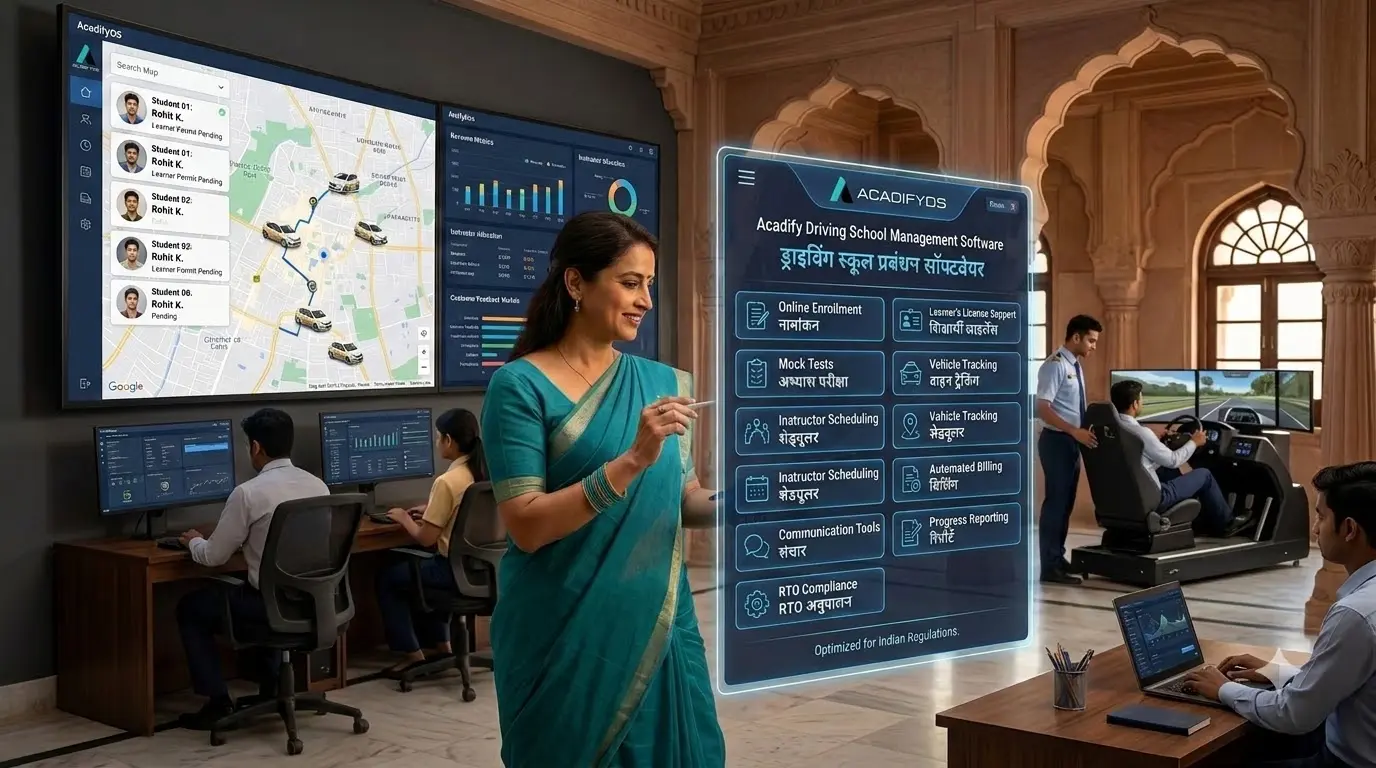
India’s driving school industry is going through a quiet but decisive shift. What used to be an unorganised network of individual instructors and neighbourhood driving schools is rapidly consolidating into professional, multi-branch training businesses, driven by rising vehicle ownership, stricter RTO enforcement, and growing demand for structured, safety-first training. Yet most driving schools still run day-to-day operations on WhatsApp groups, paper registers, and Excel sheets — a serious bottleneck once a school grows beyond one instructor and one vehicle. That is exactly the gap that driving school management software is built to close.
A purpose-built driving school management software brings instructor scheduling, learner records, fee billing, RTO test tracking, and lead follow-up onto a single dashboard, so owners spend less time chasing paperwork and more time growing enrolments. In this guide, we break down the nine must-have features every Indian driving school — from a single-branch operation to a multi-city franchise — should look for before choosing a platform, along with practical tips for evaluating vendors in 2026.
Table of Contents
What Is Driving School Management Software?
Driving school management software is a cloud-based platform built specifically for motor training institutes, driving academies, and RTO-authorised schools to manage every part of their operations — instructor and vehicle scheduling, learner enrolment, lesson-hour tracking, fee collection, attendance, and test-date reminders — from one system. Instead of juggling separate tools for phone calls, cash receipts, and paper diaries, a driving school owner logs into one dashboard to see which instructor is free, which learner’s LL is about to expire, and which fee instalment is overdue.
For Indian driving schools, this matters more than in most other academy categories because the business involves physical assets (vehicles), hard regulatory milestones (LL and DL tests at the RTO), and a high volume of short-duration cash transactions — all of which are difficult to track manually once a school crosses a handful of vehicles or opens a second branch. Good driving school management software turns these moving parts into one connected, searchable system that any staff member can operate confidently, even during peak enrolment season.
9 Must-Have Features in Driving School Management Software for India
Not every scheduling app or generic CRM qualifies as real driving school management software. The features below are the ones that separate a platform built for Indian motor training schools from a generic tool bolted together for a different industry.
1. Instructor and Vehicle Scheduling
Scheduling is the operational core of any driving school, and it is the first place manual systems break down. A single instructor might teach three learners a day across two vehicles, while another vehicle sits idle because nobody checked its calendar. Driving school management software solves this with a real-time scheduling grid that maps every learner session to a specific instructor and vehicle, flags double-bookings before they happen, and accounts for vehicle downtime such as servicing or insurance renewal.
Owners running two or three cars can see, at a glance, which vehicle has spare slots this afternoon and which instructor is free tomorrow morning. This single feature alone often pays for the software within the first month, simply by eliminating idle vehicle time and instructor double-bookings that used to cost schools multiple lesson slots a week.
2. Learner’s License (LL) and Permanent License (DL) Test-Date Tracking
Every learner passes through two hard regulatory checkpoints: the Learner’s License (LL) test and the Permanent Driving License (DL) test at the RTO. Missing either date, or showing up unprepared, wastes a training slot and damages trust. Driving school management software tracks each learner’s LL and DL status, application date, test date, and result in one record, so front-desk staff never have to dig through a register to answer “when is my test?”
Because RTO scheduling varies by state and by transport office, this feature needs to support manual date entry as well as bulk updates when the RTO releases a new test slot list. A driving school management software platform that keeps LL and DL milestones visible on a single learner timeline also makes it far easier to plan lesson pacing so a learner is genuinely test-ready by their scheduled date.
3. Lesson-Package and Hours-Remaining Tracking
Most Indian driving schools sell training in packages — a 10-hour two-wheeler package, a 15-hour car package, a 20-hour refresher package for nervous drivers. Tracking exactly how many hours a learner has consumed versus how many remain is nearly impossible on paper once a school has more than a few dozen active learners at a time.
Driving school management software logs every completed session automatically against the learner’s purchased package, shows hours-remaining in real time, and flags learners who are close to running out so the front desk can offer a top-up package before the learner drifts to a competitor. This directly protects revenue: schools that track hours accurately convert far more package renewals than schools relying on an instructor’s memory or a handwritten card.
4. Fee and Installment Billing
Driving lessons in India are frequently paid in cash, in instalments, or partly upfront with the balance due after the LL test. Reconciling this manually across dozens of learners is one of the most common sources of revenue leakage for small and mid-sized schools. A proper fee and instalment billing module inside driving school management software records every payment against the learner’s package, auto-generates digital receipts, and flags overdue instalments before they become bad debt.
The best platforms also support partial payments, multiple payment modes (cash, UPI, card), and automatic instalment reminders sent to the learner’s phone — removing the need for front-desk staff to manually track who owes what. For a franchise operation, consolidated fee reporting across branches also gives the owner a single, trustworthy revenue number instead of separate ledgers per location.
5. Digital Attendance for Practical Driving Sessions
Unlike a classroom course, a driving lesson happens on the road, which makes attendance disputes common — a learner claims they attended a session the instructor says never happened, or vice versa. Digital attendance for practical sessions, marked by the instructor at pickup and drop-off from a mobile app, removes this ambiguity entirely and creates a time-stamped record tied to the learner’s package hours.
This is one area where general-purpose attendance management software built for classroom coaching falls short — it was not designed for mobile, on-road check-ins. Driving school management software needs attendance capture that works reliably in the field, syncs automatically once the instructor’s phone reconnects to the internet, and updates hours-remaining the moment a session is logged.
6. Automated Reminders for RTO Test Dates
A missed RTO test date is one of the most frustrating outcomes for both the learner and the driving school — it delays the learner’s licensing timeline and wastes the school’s administrative effort in rebooking. Automated WhatsApp and SMS reminders sent a few days and again a few hours before the scheduled LL or DL test date dramatically cut no-shows.
Driving school management software should trigger these reminders automatically based on the test date stored in the learner’s record, without requiring a staff member to remember to send them manually. Some schools report cutting missed-test rates by more than half simply by switching on automated reminders, since many no-shows are genuinely accidental rather than deliberate.

7. Lead Capture for Walk-Ins and Online Enquiries
Driving schools generate enquiries from multiple channels — a walk-in at the office, a phone call, a Facebook or Google ad click, or a WhatsApp message from a referral. Without a structured system, many of these enquiries are noted on a scrap of paper or a personal phone and simply forgotten once the front desk gets busy. Strong lead follow-up automation built into driving school management software captures every enquiry in one pipeline, assigns it to a staff member, and schedules automatic follow-up reminders until the lead either enrols or is marked lost.
Given how price-sensitive and comparison-heavy the driving school category is in most Indian cities, the school that follows up fastest and most consistently usually wins the enrolment — not necessarily the cheapest one. Driving school management software with built-in lead capture directly protects against the silent revenue loss of enquiries that are never called back.
8. Multi-Branch Support for Franchise Driving Schools
As driving schools scale into two, three, or a dozen branches across a city or state, owners need visibility across every location without physically visiting each one. Multi-branch support inside driving school management software consolidates instructor rosters, vehicle inventories, learner enrolments, and revenue into one dashboard, while still letting each branch manager operate their own day-to-day schedule independently.
This is the same operational logic that has made centralised academy management software indispensable for multi-location coaching chains and sports academies alike — a franchise driving school owner should be able to compare branch performance side by side, spot which location is under-utilising its vehicles, and roll out pricing or package changes across every branch from one place instead of visiting each office individually.
9. Student Progress and Skill Checklists
A learner’s readiness for the DL test depends on more than hours logged — it depends on specific skills: parking, reversing, lane discipline, highway driving, and traffic-signal handling. Digital skill checklists let instructors mark each competency as the learner progresses, building a visible skill record instead of a vague “they’re doing fine” verdict.
This progress data is useful in two ways: it gives the school objective evidence of training quality (useful for RTO audits and for parents who often pay for teenage or first-time drivers), and it flags learners who need extra practice on a specific skill before their test date rather than generic extra hours. Driving school management software that ties skill checklists to the same learner record as scheduling, hours, and billing gives owners a complete picture of every learner’s journey from enrolment to licence.
Why Indian Driving Schools Can’t Rely on Manual Systems in 2026
Regulatory scrutiny of motor training in India has increased steadily, with the Ministry of Road Transport & Highways pushing states to formalise driver training standards, including accredited driving training centres with structured curricula and documented practical hours. Schools that cannot produce clean, auditable records of learner hours, instructor assignments, and test outcomes are at a real disadvantage as this formalisation continues.
Beyond compliance, the business case is straightforward. A school running on paper registers typically loses track of a meaningful share of billable hours through scheduling gaps, forgotten package renewals, and missed follow-ups on enquiries. Driving school management software recovers most of that lost revenue automatically — vehicles are booked more tightly, package renewals are offered before hours run out, leads are followed up consistently, and fee collection is proactive rather than reactive. For an owner managing this across two or three branches, the difference between manual tracking and proper driving school management software is often the difference between breaking even and running a genuinely profitable, scalable business.
How to Choose the Right Driving School Management Software
Not all platforms marketed as driving school management software are actually built for the category — many are generic scheduling or CRM tools with a driving-school label added on. When evaluating vendors, check for these specifics:
- Does it track LL and DL test dates as first-class fields, not a generic “notes” box?
- Does it handle vehicle-level scheduling, not just instructor calendars?
- Can it track lesson packages and hours-remaining automatically, without manual recalculation?
- Does it support cash, UPI, and instalment billing common to the Indian driving school market?
- Can it run multiple branches from one login, the way a broader academy management software platform does for multi-location academies?
- Does it capture and follow up on leads automatically, similar to how a sports academy CRM nurtures enquiries into enrolments for sports academies?
A driving school management software platform that checks every box above will typically pay for itself within a few months through recovered vehicle utilisation, better package renewals, and fewer lost leads — well before accounting for the hours saved on daily admin.
Frequently Asked Questions
What is driving school management software?
Driving school management software is a cloud-based platform that helps driving schools and motor training institutes manage instructor and vehicle scheduling, learner records, LL and DL test tracking, fee billing, attendance, and lead follow-up from a single dashboard, replacing paper registers and WhatsApp-based tracking.
How much does driving school management software cost in India?
Pricing varies by vendor and by the number of branches, vehicles, and instructors you manage, but most Indian driving schools pay a monthly subscription based on active learners or branch count rather than a large upfront licence fee. Request a demo to get pricing matched to your school’s size.
Can this software track LL and DL test dates for every learner?
Yes. A proper driving school management software platform stores each learner’s Learner’s License and Permanent License test dates, application status, and result as dedicated fields, and can send automated WhatsApp or SMS reminders before each RTO test date to reduce no-shows.
Is driving school management software useful for a single-branch school, or only franchises?
It benefits both. A single-branch driving school gains from tighter vehicle scheduling, package tracking, and lead follow-up, while a multi-branch franchise additionally gets consolidated reporting and centralised control across every location from one login.
How does this software help with fee collection and instalments?
It records every payment against a learner’s package in real time, supports cash, UPI, and instalment payments common in India, auto-generates digital receipts, and sends automated reminders for overdue instalments, reducing the manual follow-up burden on front-desk staff.
Get Started with Driving School Management Software Built for India
Running a driving school in India in 2026 means competing against schools that have already digitised instructor scheduling, RTO test tracking, fee billing, and lead follow-up. Staying on paper registers and WhatsApp groups is no longer just an inconvenience — it is a direct drag on enrolments, vehicle utilisation, and revenue. The right driving school management software brings every one of the nine features above into a single system built specifically for motor training schools, not adapted from a generic scheduling tool.
AcadifyOS gives Indian driving schools and franchise motor training networks a single platform for scheduling, LL/DL tracking, fee billing, attendance, lead capture, and multi-branch reporting. Start Free Trial to see how quickly your team adapts, or Book a Demo to get a walkthrough tailored to your driving school’s branches, vehicle count, and enrolment volume.
Discussion
Comments