
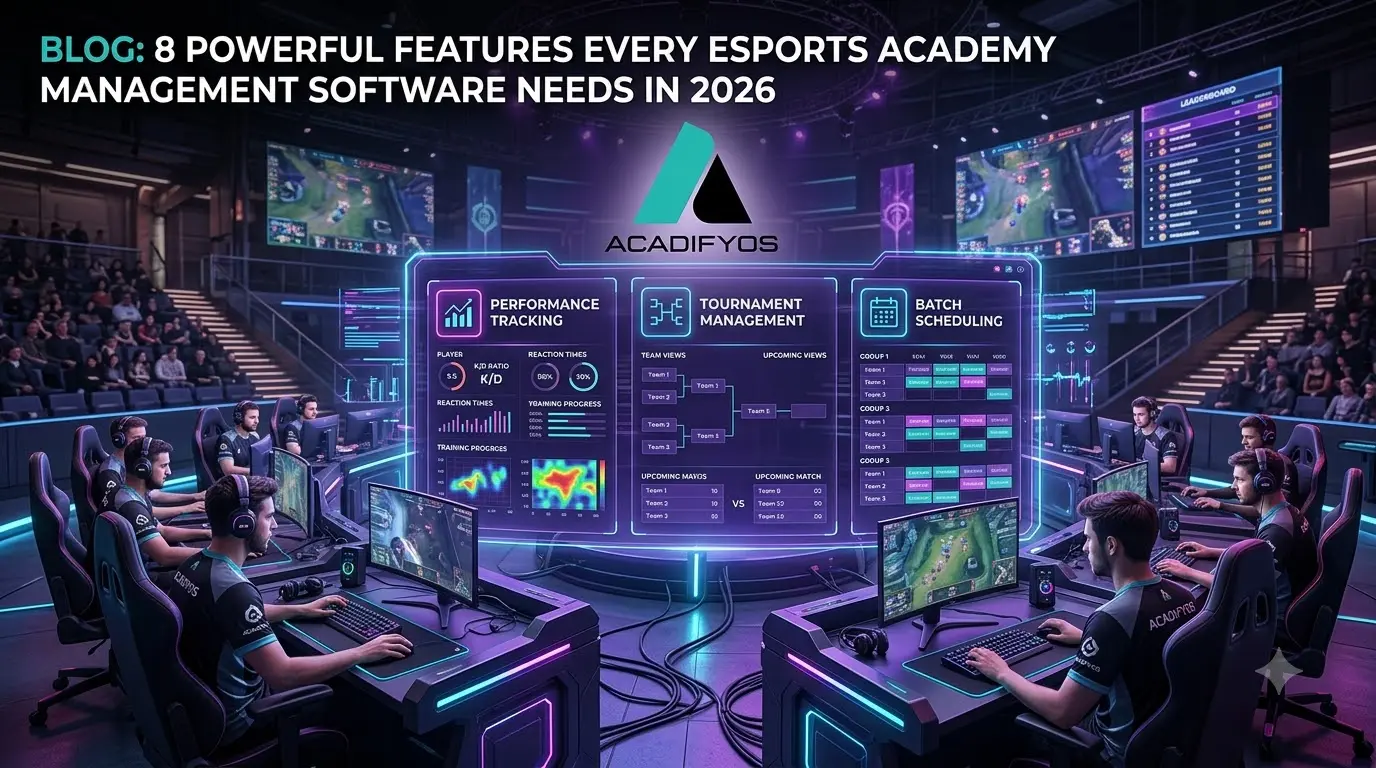
India’s esports scene has gone from college LAN parties to a billion-dollar industry in under five years. BGMI’s return, the rise of Valorant and Free Fire tournaments, and multi-crore prize pools have turned casual gaming cafes into structured training academies with rosters, coaches, and scrim schedules. But most of these academies are still coordinating everything through Discord pings, WhatsApp groups, and spreadsheets that break down the moment a batch crosses 40-50 players. That’s exactly the gap purpose-built esports academy management software is designed to close.
In this guide, we break down the eight features every serious esports academy management software platform must have in 2026 — whether you’re running a single-title academy out of a gaming cafe or a growing multi-game franchise with players spread across three cities and multiple state qualifiers to prepare for every season.
Table of Contents
What Is Esports Academy Management Software?
Esports academy management software is a purpose-built platform that replaces the spreadsheets and chat groups esports academies use to manage players, tournaments, and payments. Instead of manually tracking who showed up for scrims, whose parents haven’t paid this month’s fee, or which player is due for a performance review, the software centralizes rosters, scrim schedules, fee collection, and coach feedback in one dashboard — so coaches spend their time coaching, not chasing admin. Unlike generic sports-club software repurposed for gaming, a platform built specifically for esports understands squad structures, patch-driven schedule changes, and per-title batch economics from the start, instead of forcing coaches to bend gaming workflows around a tool designed for cricket nets or badminton courts.
8 Must-Have Features in Esports Academy Management Software
1. Player Roster & Squad Management
The foundation of any esports academy management software platform is a clean, searchable roster. Coaches need to group players into squads by game title (BGMI, Valorant, Free Fire, CS2), track in-game IDs and ranks, and reassign players between squads as skill levels shift — without losing history on attendance or performance. Without this level of organization, coaches end up scrolling through weeks of chat history just to confirm who’s actually on a squad this month.
2. Tournament & Scrim Scheduling
A real esports academy management software solution replaces the group-chat scramble to fix scrim timings. Coaches should be able to publish a scrim and tournament calendar, auto-notify the right squad, and track RSVP and no-show rates by player — critical when a single missed scrim can cost a team its qualifier slot. Academies that skip this step usually discover the cost only after a top player misses a qualifier because the schedule change never reached them.
3. Performance Analytics Dashboard
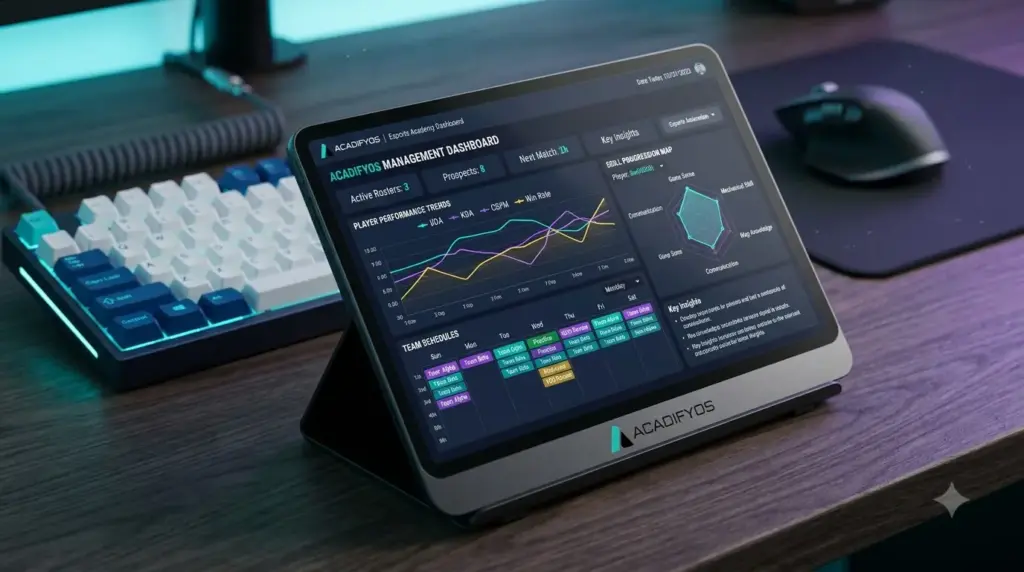
Kill-death ratios, win rates, and objective control don’t mean much scattered across screenshots. A strong esports academy management software tool pulls per-player and per-squad performance trends into one dashboard, so coaches can spot who’s peaking before a tournament and who needs extra individual coaching time. Over a full season, this turns anecdotal ‘he’s improving’ feedback into a defensible case for promoting — or benching — a player.
4. Coaching Session & VOD Review Tracking
Esports coaching runs on video review as much as live practice. The software should let coaches log VOD review sessions against each player’s profile, attach notes and timestamps, and track whether a flagged issue — like poor rotations or late utility usage — actually improves over subsequent sessions. This is also the fastest way to prove to a skeptical parent that coaching time is actually translating into measurable in-game improvement.
5. Fee & Sponsorship Payment Management
Between monthly training fees, tournament entry costs, and sponsorship payouts to top players, esports academy finances get messy fast. A dedicated esports academy management software platform automates fee reminders over WhatsApp and SMS, tracks partial payments, and gives owners a clear view of collections versus dues at any point in the season. Academies that automate this step routinely collect fees 5-7 days faster than those still sending manual WhatsApp reminders one parent at a time.
6. Parent Communication & Progress Reports
Unlike traditional sports, many Indian parents are still skeptical about esports as a serious pursuit. Academies that send parents clean, professional progress reports — attendance, tournament results, skill development — build trust and retain students far longer than academies that rely on word-of-mouth reassurance alone. That trust compounds — parents who see clear proof of progress are far more likely to renew for another season instead of quietly dropping out.
7. Multi-Game Batch Management
Most Indian esports academies don’t specialize in a single title — they run BGMI, Valorant, and Free Fire batches under one roof to maximize facility usage. The software needs to handle overlapping batch timings, shared gaming-PC or console inventory, and per-game fee structures without coaches manually cross-checking three separate spreadsheets. Getting this wrong is the single biggest source of double-booked PCs and overlapping coach schedules in academies that scaled past their original spreadsheet.
8. Automated Lead Follow-Up for Trial Enrollments
Esports academies lose a large share of trial sign-ups simply because no one follows up fast enough after an Instagram DM or a walk-in inquiry. Built-in lead follow-up automation — inspired by the same lead follow-up automation approach used by sports academies — nudges prospective players and parents automatically until they convert or opt out. Academies that plug this gap typically see trial-to-enrollment conversion rise by a third simply because no promising player falls through the cracks.
Academies that adopt dedicated esports academy management software consistently report fewer no-shows, faster fee collection, and — most importantly — better tournament results, because coaches are spending their hours on strategy instead of admin. The underlying operational discipline is the same one that has helped traditional sports academy CRM adopters scale from a single batch to a multi-city academy.
Why India’s Esports Boom Needs Better Software, Not Just Better Players
The Esports Federation of India now oversees a national circuit that feeds directly into international qualifiers, which means academies are no longer competing just on talent — they’re competing on how consistently they can prepare players, track improvement, and keep families paying and engaged over a multi-year journey. That consistency is exactly what a proper academy management software platform, purpose-fit for esports, is built to deliver.
If your academy is still tracking rosters in a spreadsheet and fees in a notebook, the same attendance management software discipline that transformed traditional sports academies is now available for esports — and the academies that adopt it early are the ones building the strongest reputations heading into 2026’s tournament calendar.
This shift is already visible at the grassroots level: college fests now run dedicated BGMI and Valorant brackets, tier-2 city gaming cafes are rebranding as academies, and parents who once dismissed gaming as a distraction are asking coaches for structured, career-track training plans. Academies that can show — not just claim — organized progress through clean dashboards and reports are the ones winning that trust first.
How to Choose the Right Esports Academy Management Software for Your Setup
Not every esports academy management software platform is built the same way, and picking the wrong one can mean paying for features a gaming-cafe-turned-academy will never use. Before signing up, run through a short checklist against your actual day-to-day operations rather than the marketing page.
Does it support your specific games?
Confirm the platform can handle squad structures for your actual title mix — BGMI’s four-player squads look nothing like a Valorant five-stack or a solo Free Fire roster, and a rigid tool forces you to work around it instead of the other way round.
Can it handle irregular scrim timings?
Esports schedules shift constantly around patch updates and tournament brackets. A rigid weekly-recurring calendar built for traditional sports coaching won’t survive contact with a real scrim schedule — look for one-off and recurring slots that can be rearranged in seconds.
Is fee collection built for India?
UPI-first payment links and WhatsApp/SMS reminders matter more here than card-based checkout — most Indian esports parents pay fees the same way they pay for groceries, and the software should meet them there.
Does it scale past one game title?
An academy that starts with just BGMI today is very likely to add Valorant or Free Fire batches within a year as demand grows — pick software that handles multi-game batch management from day one instead of a single-title tool you’ll outgrow.
Academies that go through this checklist before committing to a esports academy management software vendor avoid the most common mistake in the category: paying for a generic sports-club tool that was never actually designed for how gaming academies operate day to day. A quick trial run with your real roster — not a demo dataset — is usually enough to reveal whether a platform actually fits, or whether it will need workarounds within the first month.
What Does Esports Academy Management Software Actually Cost — and Is It Worth It?
Most Indian esports academies assume dedicated software is a big-studio expense, but pricing for esports academy management software usually scales with player count, not facility size — a 30-player single-title academy pays a fraction of what a multi-city, multi-game operation pays, and most vendors offer monthly plans with no long-term lock-in.
The real ROI question isn’t the subscription fee, it’s what manual admin is already costing you. A coach who spends even five hours a week chasing fee payments and rebuilding scrim schedules in a spreadsheet is losing time that should go into VOD review and strategy sessions — the actual work that wins tournaments and keeps players enrolled season after season.
Academies that switch to a proper esports academy management software platform typically recover that lost coaching time within the first month, and the faster fee collection alone — 5 to 7 days quicker on average — often covers the subscription cost outright. Combined with fewer no-shows and higher trial-to-enrollment conversion, most academy owners consider it one of the highest-return decisions they make in their first year of scaling beyond a single squad.
Frequently Asked Questions
What is esports academy management software?
It’s a platform built specifically for gaming academies to manage player rosters, scrim and tournament schedules, performance analytics, and fee collection in one place, instead of coordinating everything across Discord, WhatsApp, and spreadsheets that quickly become unmanageable as an academy grows past a single squad.
Do small esports academies really need dedicated software, or is a spreadsheet enough?
A spreadsheet works for a single squad of 5-10 players, but once an academy runs multiple game titles and 40+ players across several batches, tracking attendance, fees, and performance manually becomes the biggest bottleneck to scaling — dedicated esports academy management software removes that ceiling and lets coaches focus on training instead of admin.
Can this software manage multiple game titles like BGMI, Valorant, and Free Fire under one academy?
Yes — a good esports academy management software platform supports multi-game batch management, so coaches can run separate squads, schedules, and fee structures per title without juggling multiple spreadsheets.
How does the software help with parent trust in esports as a career path?
By generating clean, professional progress reports covering attendance, tournament results, and skill development, academies can show parents tangible proof of progress, which builds long-term trust and improves retention.
How long does it take to set up an esports academy on this kind of platform?
Most academies are fully onboarded — rosters imported, batches created, and fee reminders configured — within a week, running the new system alongside existing WhatsApp groups until the transition is complete.
Ready to Level Up Your Esports Academy?
India’s next esports champion is training in an academy right now — and the academies that give players the best structure, from scrim scheduling to performance tracking, will be the ones producing tournament winners, not just talented individuals who burn out under disorganized coaching. Book a Demo to see how esports academy management software can run your academy’s admin, or Start Free Trial today and keep your focus where it belongs — on the scoreboard.
Discussion
Comments